
Binance vs OKX: Which Is Right for You?
An honest side-by-side of Binance and OKX — trading fees, availability by region, KYC, security, and products — with a clear rule for choosing.
 Lucas Almeida 5 min read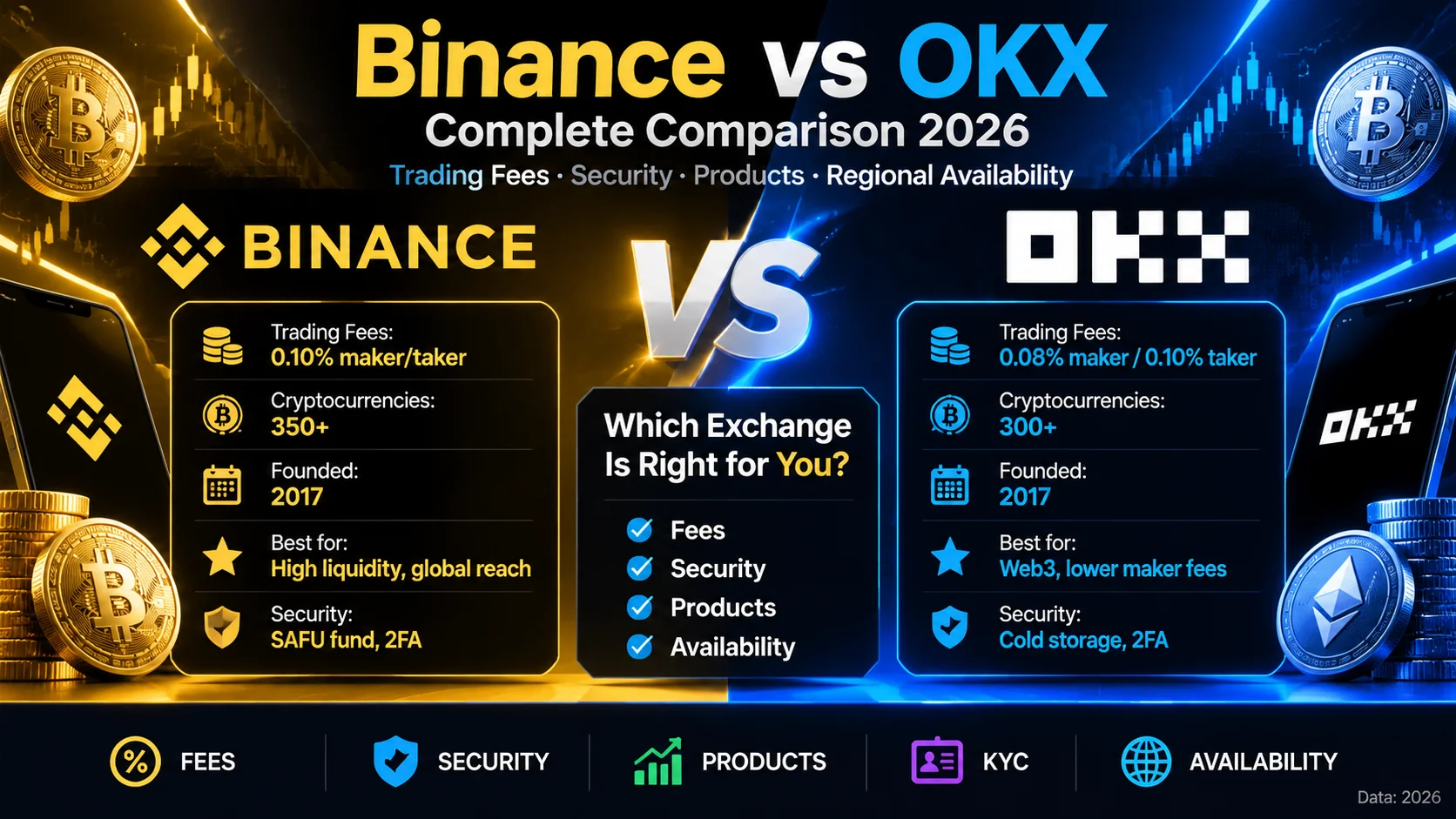
Key takeaways
- There is no universal winner between Binance and OKX. For many people the decision is already made by where they live — OKX is licensed in more regulated markets, including the US, UK, and EEA.
- On fees, both charge 0.10% for spot taker orders. OKX is cheaper only on maker (limit) orders at 0.08%, while Binance can undercut both to 0.075% if you pay fees with BNB.
- Binance has the deepest liquidity and the most listed coins; OKX has a stronger built-in Web3 wallet and a more professional unified trading account.
- Registration differs: Binance asks for email or phone, OKX requires both — and an OKX referral code must be entered at sign-up, with no way to add it later.
- Both publish proof-of-reserves and both have regulatory history to weigh. The deciding factors for most beginners are availability, funding rails, and which platform you find easier to use.
There is no single “better” exchange between Binance and OKX — for many people the decision is already made by where they live, because OKX is licensed in more regulated markets (the US, UK, and EEA) while Binance is restricted in several. If both are available to you, the honest summary is this: Binance leads on liquidity, listed coins, and its BNB fee discount; OKX leads on regulatory access, spot maker fees, and a stronger built-in Web3 wallet.
This guide walks through the differences that actually matter — fees, availability, KYC, security, and products — and ends with a decision rule you can apply to your own situation.
Binance vs OKX at a glance
Here is the whole comparison compressed into one table. The sections that follow explain each row.
| Binance | OKX | |
|---|---|---|
| Spot fee (base) | 0.10% maker / 0.10% taker | 0.08% maker / 0.10% taker |
| Spot fee (with token) | 0.075% with BNB (25% off) | No token discount — lower at VIP tiers only |
| Futures fee (base) | 0.02% maker / 0.05% taker | 0.02% maker / 0.05% taker |
| Regulatory reach | Restricted in US, UK, EEA | US, UK, EEA, Singapore |
| Listed assets | ~470+ coins | ~300 coins |
| Liquidity | Deepest order books | Close on major pairs |
| Standout product | Launchpad, Earn, P2P breadth | Web3 wallet, options, unified account |
| KYC model | Single upload + face, two levels | Lv1 + Lv2 |
The rest of this guide unpacks each row so you can see which differences matter for you.
Which exchange can you actually use?
This is the first question to answer, because it overrides everything else. If one exchange is not licensed in your country, the comparison ends there.
Availability changes as regulators move, so treat this as a snapshot (checked October 2026) and confirm on each exchange’s official site before you commit:
| Market | Binance | OKX |
|---|---|---|
| United States | Global platform closed to US residents; Binance.US is a separate, reduced entity | Serves most US states through a licensed entity |
| United Kingdom | Not open to new retail customers on the global platform | Available |
| European Economic Area | Global platform services suspended in mid-2026 under MiCA | Available, with a MiCA license |
| Singapore | Restricted for many retail services | Available |
| Most of the rest of the world | Broad coverage | Broad coverage |
The pattern is consistent: Binance has been pulling back from regulated Western markets, while OKX has been leaning into them. If you live in the US, UK, or EEA, OKX is often the only one of the two you can realistically use. This is not a quality judgment — it is the practical starting point.
If both are available where you are, the rest of this guide matters.
What are the trading fees on each exchange?
Fees are where the two are closest, and where most comparison pages either oversimplify or get the maker/taker detail wrong.
Spot trading (base level):
| Exchange | Maker fee | Taker fee |
|---|---|---|
| Binance | 0.10% | 0.10% |
| Binance with BNB | 0.075% | 0.075% |
| OKX | 0.08% | 0.10% |
Futures (perpetuals, base level):
| Exchange | Maker fee | Taker fee |
|---|---|---|
| Binance | 0.02% | 0.05% |
| OKX | 0.02% | 0.05% |
Two conclusions fall out of these tables:
- For taker orders (market orders), they are tied. Both charge 0.10% on spot and 0.05% on futures at the base level. If you buy and sell with market orders, the fee difference is zero.
- The differences are at the edges. OKX is cheaper on spot maker orders (0.08% vs 0.10%), while Binance becomes the cheapest spot option of the three if you hold BNB and pay fees with it (0.075%).
A quick reminder on the terms, because this is the one detail that flips the answer: a maker order sits on the order book (a limit order that is not filled instantly), and a taker order fills against an existing order (a market order). Beginners placing market orders pay the taker rate on both platforms.
The BNB discount is Binance’s strongest fee lever. Holding BNB and enabling “pay fees with BNB” cuts the spot fee 25% (to 0.075%) and the futures fee 10% (to 0.045%). OKX has no equivalent token discount today — its own FAQ confirms OKB does not reduce fees — so its only fee lever is rising through VIP tiers. For a casual spot buyer, the BNB discount is the easiest, clearest saving — see our Binance fees guide for the full math. Fees change regularly, so confirm current rates on each exchange’s fee page before a large trade.
How do registration and KYC compare?
This is where the two exchanges differ in ways that actually affect your first hour, and it is worth getting right before you start.
| Binance | OKX | |
|---|---|---|
| Sign-up requirement | Email or phone number | Email and phone number |
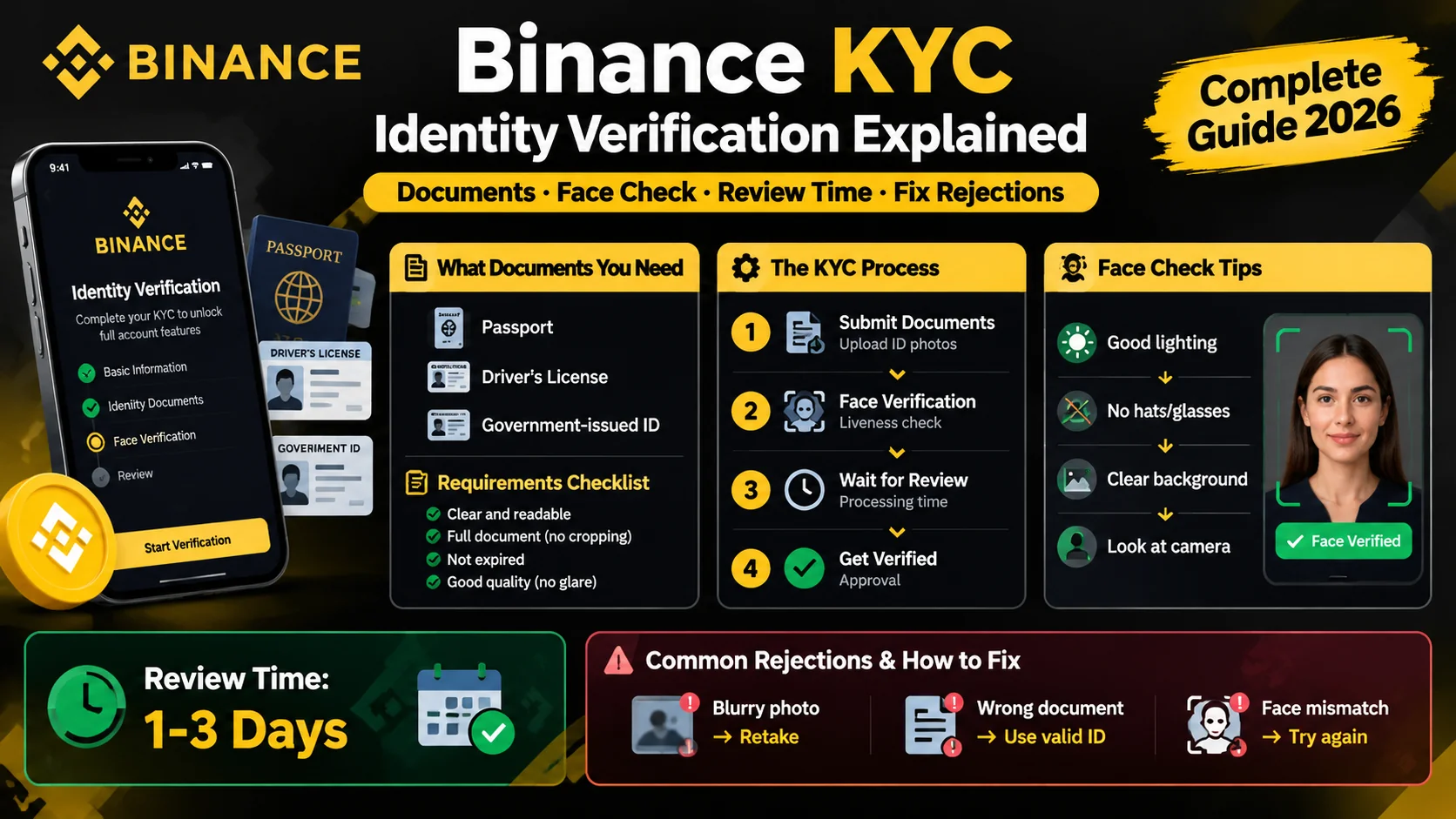
| KYC model | Single ID upload + face check | Lv1 (name + ID), then Lv2 (ID photo + face) |
| Referral code timing | Usually enterable at sign-up | Must be entered at sign-up, cannot be added later |
| Verification review | Usually minutes, up to 48 hours | Usually 10–30 minutes, up to 24 hours |
Three practical takeaways:
- OKX requires both email and phone, which adds one step to sign-up but gives you two recovery channels. Binance is faster to start with just one.
- OKX’s referral code is locked in at sign-up — there is no “I’ll add it later.” If you have a code, enter it during registration. Read how OKX referral codes work and how Binance referral codes work for the details.
- Both gate everything behind KYC. Neither lets you deposit, trade, or withdraw until your identity is verified.
For the full step-by-step flows, see how to create a Binance account and how to create an OKX account.
How do they compare on security and reserves?
Both exchanges are large, established platforms, and both publish proof that customer deposits are backed. Neither is risk-free, and both have regulatory history worth understanding before you trust either with serious money.
Proof of reserves. Binance publishes a Merkle-tree proof-of-reserves and maintains a $1 billion SAFU insurance fund to reimburse users in certain loss events. OKX publishes monthly proof-of-reserves verified with zk-STARK proofs, widely described as the most transparent reserve reporting in crypto — its mid-2026 snapshot showed over $23 billion in primary assets.
Regulatory history. Binance paid a $4.3 billion settlement with US authorities and now operates under an independent compliance monitor. OKX has also paid a US penalty and has kept a comparatively lower regulatory profile, focusing on Dubai, Singapore, and select Asian markets. Neither is “clean,” and honest sources treat both histories as relevant context rather than deal-breakers.
Incident response. Both have experienced security incidents in the past and both have reimbursed affected users. OKX added a 24-hour delay on large withdrawals after one incident, an example of the kind of control that protects funds when an account is compromised.
The practical takeaway for a beginner is not “pick the safer exchange” — it is that exchange safety is only half the story. Any exchange account is only as safe as your own login security: use a strong unique password, turn on two-factor authentication with an authenticator app, and move amounts you plan to hold long-term into a wallet you control. Our guides to private keys and KYC cover both halves.
What products does each exchange offer?
If you are new, you will use a small fraction of what either platform offers. But the differences in what is there shape how each feels as you grow.
Binance is the breadth leader: the deepest order books in crypto (reported at roughly 38% of top-exchange spot volume in mid-2026), around 470+ listed coins, and the widest product range — spot, margin, futures, options, P2P, a staking/Earn hub, and Launchpad token sales. It also has the largest ecosystem of third-party trading bots and API integrations.
OKX is close on major-pair liquidity but lists fewer coins (around 300). Where it pulls ahead is on the tooling: a unified trading account with portfolio margin across products, one of the most liquid options markets outside Deribit, demo trading accounts for practice, and the more developed built-in Web3 wallet — supporting 80+ blockchains with a DEX aggregator, which makes moving between the exchange and self-custody much smoother.
The beginner’s version of all that: Binance feels like the biggest supermarket — everything is there. OKX feels like a more integrated platform for someone who plans to move between trading and the on-chain world. If you are unsure what any of these products are, start with what cryptocurrency is before diving in.
Binance vs OKX: which should you choose?
Rather than a fake “winner,” here is a decision rule you can run yourself.
Choose OKX if any of these apply:
- You live in the US, UK, or EEA, where Binance is restricted.
- You place limit orders and want the lower 0.08% spot maker fee.
- You want to move frequently between an exchange and your own wallet via a built-in Web3 wallet.
- You trade options or want a unified account with portfolio margin.
- You want demo trading before risking real money.
Choose Binance if any of these apply:
- You live in a country Binance serves and want the deepest liquidity for larger trades.
- You hold (or are happy to hold) BNB to unlock the 25% spot fee discount.
- You want the broadest list of coins and Earn/staking products.
- You prefer the largest ecosystem of bots, integrations, and tutorials.
Choose either (or both) if:
- You are a beginner just buying your first crypto — the basics are the same on both, and the differences above barely affect a small first purchase.
A lot of people hold both: Binance for liquidity and Earn, OKX for Web3 access or because it is the one licensed where they live. The only real cost of both is that you now have two accounts to keep secure.
What should you watch out for?
- Availability changes. The MiCA suspension of Binance’s EEA services happened in mid-2026 with little notice for some users. Treat every availability and fee figure in this guide — including this one — as a snapshot, and confirm your country’s status on the official site before you register.
- Fees change too. Both exchanges revise fee schedules and discount programs. The BNB discount percentage, in particular, has moved over time. Check the live fee page rather than trusting a table from memory.
- “Which is better” pages are often affiliate pitches. Many comparison articles rank whichever exchange pays them more. This article links to both platforms, and the decision rules above work regardless of which link you use.
- Security is on you, not just the exchange. The biggest risk for most beginners is not the exchange’s reserves but a reused password, a phishing link, or a skipped two-factor setup. Neither Binance nor OKX can protect you from those.
The bottom line
Binance and OKX are both excellent, and the honest answer to “which is better” is “it depends on you.” OKX wins on regulatory access (US, UK, EEA), spot maker fees, and Web3 integration; Binance wins on liquidity, listed coins, and the BNB fee discount. For many people the choice is made by jurisdiction before they even compare features. If you can choose, start from the decision rule above — and whichever you pick, complete KYC, turn on 2FA, and keep your long-term holdings in a wallet you control.
Ready to start? Here is how to create an OKX account and how to create a Binance account, then compare OKX referral codes and Binance referral codes before you sign up.
Don't have a Binance account yet?Sign up nowenter the referral codeBN2688
Frequently asked questions
Which is better, Binance or OKX?
Is OKX cheaper than Binance?
Is OKX available in the United States?
Is Binance available in Europe?
Do Binance and OKX require ID verification?
Which exchange is safer, Binance or OKX?
Can I use both Binance and OKX?
Which exchange should a beginner start with?
Editor-in-Chief & Lead Researcher
Editor of MyCryptoStart. Independent researcher of cryptocurrency exchanges, focused on fees, security, KYC, and onboarding — publishes step-by-step guides in plain English for beginners.
View author page →Some links on this page are affiliate links: we may earn a commission at no extra cost to you. This content is educational and is not financial, investment, or legal advice. Affiliate disclosure · Disclaimer.
Continue reading
Is Binance Safe? How It Protects Your Funds
Is Binance safe in 2026? How SAFU, cold storage, and Proof of Reserves protect your funds — and where regulation and account security still carry risk.
Is OKX Safe? How It Protects Your Funds
Is OKX safe in 2026? Monthly Proof of Reserves, cold storage, and a full EU MiCA licence — plus the 2020 withdrawal freeze and US settlement risks.
Binance KYC: How Identity Verification Works
Binance requires KYC before you trade. Learn the documents you need, how the face check works, how long review takes, and how to fix rejections.