
Trading & exchanges
What Is KYC in Crypto and Why Does It Matter?
Short answer
KYC (Know Your Customer) is the identity-verification process regulated crypto exchanges must run before letting you trade: you submit a government ID and a live selfie, sometimes proof of address, and verification usually completes within minutes to a day. It exists to stop money laundering and fraud, and it cuts both ways — it exposes exchanges to law enforcement but also protects you, since verified platforms are far harder to walk away from with stolen funds.
Key takeaways
- Standard tier: government ID + live selfie. Higher limits may add proof of address or source of funds.
- Typical turnaround is minutes to 24 hours; rejected photos (glare, cropped edges) are the most common delay.
- Regulated exchanges — including Binance and OKX in most regions — require it before meaningful deposits or withdrawals.
- KYC links your identity to your trading; on-chain transfers out of an exchange are visible and traceable.
- 'No-KYC exchange' pitches are a common scam hook and a real legal risk in most countries.
Why do exchanges demand your ID?
Because the law does. Crypto exchanges sit next to banks in most regulatory systems, and anti-money-laundering rules (AML) make them responsible for knowing who moves money through their platform — no exchange gets to operate at scale otherwise. The process itself is boring and fast: photograph your passport or national ID, take a live selfie so the company can match your face to the document, occasionally prove your address for higher limits. Modern automated checks clear most people in under an hour. Our step-by-step verification guide shows exactly what each stage asks for and the mistakes that cause rejections.
Is KYC good or bad for you personally?
Both, honestly. The cost is privacy: your trading is tied to your name, and withdrawing crypto on-chain leaves a permanent, analyzable trail — the blockchain’s pseudo-anonymity ends at the exchange door. Anyone who learns the address you withdrew to can connect it to a person, which is a real change from cash.
The benefit is recourse. Verified platforms have faces, licenses, and legal exposure, which is precisely why stolen-account funds are sometimes frozen and recovered there, and why the industry’s worst collapse-and-vanish stories — exchanges that simply stopped answering — come overwhelmingly from the unregulated corners. When something goes wrong, “there is a company in a jurisdiction that answers to a regulator” is worth more than any feature list. For a beginner, that trade is worth making.
What should you watch out for?
Three things. Fake verification pages: submit documents only through the exchange’s official app or site — type the address yourself, because fake “verification” flows are a standard phishing pattern designed to harvest exactly these identity documents, and a leaked passport photo fuels identity fraud for years. Over-collection: legitimate exchanges ask for what regulation requires at your tier; nobody upgrading you to “premium verification” over DM needs your documents, they want them. The freedom pitch: “no-KYC” platforms marketed to beginners are usually either scams, sanctioned entities, or both, and using them can put you on the wrong side of your own country’s rules — the anonymity being sold is yours to lose. Getting verified once on a major exchange is the boring, correct move; our registration walkthrough covers the whole setup including 2FA in one pass.
What happens to your data after verification
Worth understanding before you submit, not after. Verified documents and selfies don’t vanish once the checkmark appears: they live in the exchange’s systems for as long as law requires — typically five years or more after account closure — accessible to the compliance team, and disclosable to regulators or courts under legal process. That’s the deal in plain terms: you get a regulated venue with recourse; they get a permanent, linkable record of your identity and (via chain analysis) much of your transaction graph.
Practical consequences, none of them reasons to skip KYC but all of them worth knowing:
- The exchange account is your most identifiable crypto footprint. Protect its security accordingly — it’s not just money at stake but your identity documents.
- Privacy on-chain is separate. Once funds leave the exchange, address reuse and public trail-building decide how traceable you are. Mixing services marketed for “privacy” add legal risk far outweighing the benefit for ordinary users.
- Breach history is real. Regulated exchanges carry obligations and security audits that unregulated ones don’t — one more reason the verification you submit should go only to top-tier platforms, and only through the official app.
Frequently asked questions
How long does KYC verification take?
Is my ID safe with a crypto exchange?
Can I use crypto without KYC at all?
Does KYC affect my taxes?
Related terms

Editor-in-Chief & Lead Researcher
Editor of MyCryptoStart. Independent researcher of cryptocurrency exchanges, focused on fees, security, KYC, and onboarding — publishes step-by-step guides in plain English for beginners.
View author page →Some links on this page are affiliate links: we may earn a commission at no extra cost to you. This content is educational and is not financial, investment, or legal advice. Affiliate disclosure · Disclaimer.
Learn more about kyc
Our full guides that cover this term in depth.
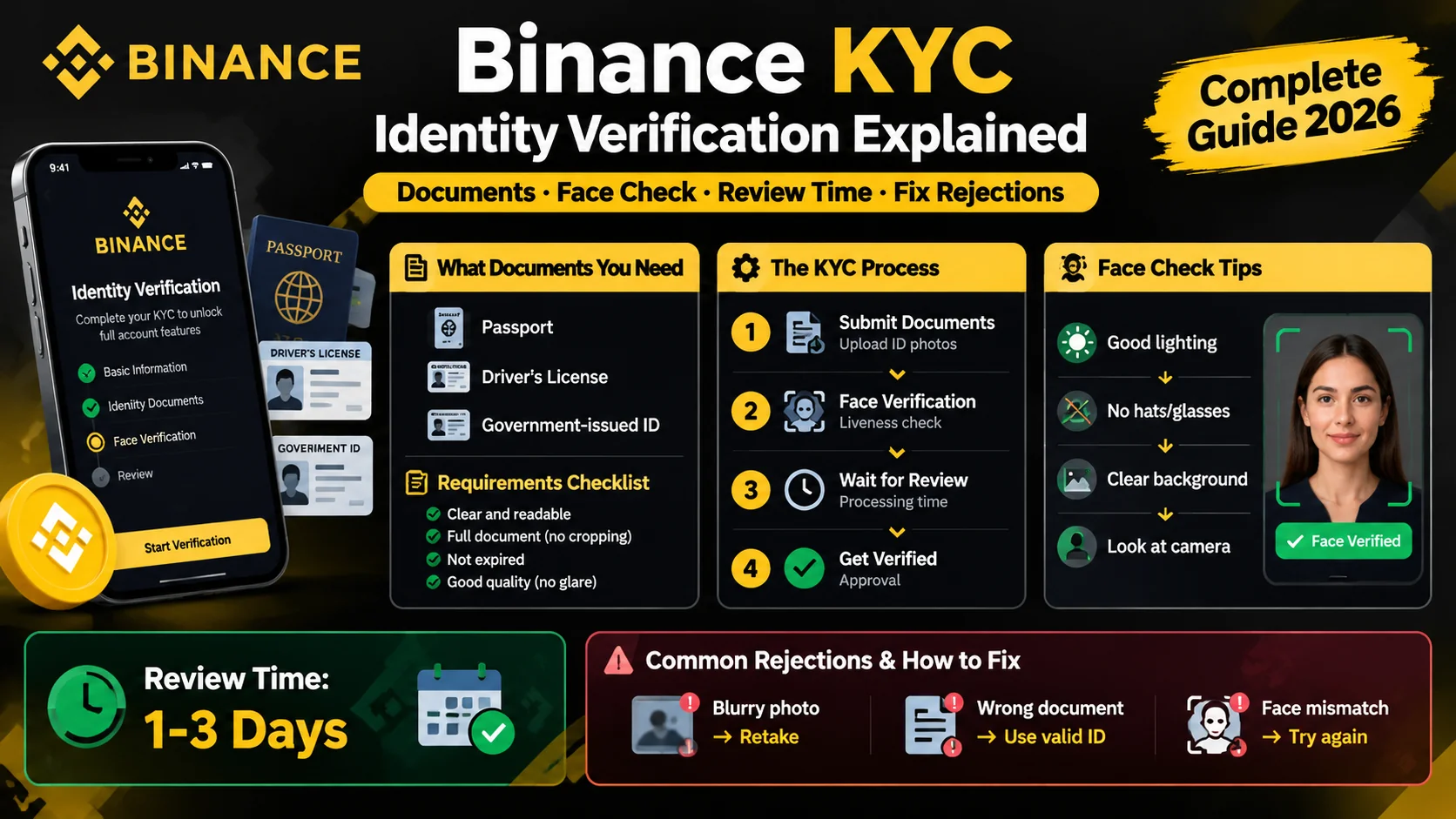
Binance KYC: How Identity Verification Works
Binance requires KYC before you trade. Learn the documents you need, how the face check works, how long review takes, and how to fix rejections.
How to Create a Binance Account (2026 Guide)
Create a Binance account in about five minutes: sign up with email or phone, verify KYC, and turn on 2FA. Step-by-step guide for beginners.
How to Withdraw from Binance (Crypto & Fiat)
How to withdraw from Binance — crypto to an external wallet or fiat to your bank — plus the fees, limits, and security settings that protect your funds.