
Is OKX Safe? How It Protects Your Funds
Is OKX safe in 2026? Monthly Proof of Reserves, cold storage, and a full EU MiCA licence — plus the 2020 withdrawal freeze and US settlement risks.
 Lucas Almeida 5 min read
 Key takeaways
- OKX has never lost customer funds to a hack, and its monthly Proof of Reserves — 47 consecutive reports, with BTC held at 109% — is the most transparent disclosure in the industry.
- Its one blemish is operational, not a breach: a five-week withdrawal freeze in October 2020 after a key holder was detained. Funds were safe, but it exposed a single-point-of-failure risk.
- On regulation OKX is ahead of most rivals in Europe — it holds a full MiCA licence (Malta, January 2025) — and its only serious enforcement was a 2025 US settlement with no allegations of customer harm.
OKX is one of the safer major exchanges, and its transparency is arguably the best in the industry: it has never lost customer funds to a hack, and it publishes a monthly Proof of Reserves showing, in its most recent report, bitcoin held at 109% of what customers are owed. Its weaknesses are unusual — a five-week withdrawal freeze in 2020 that exposed a single-point-of-failure risk, and a US$504 million US settlement in 2025. On the positive side it holds a full EU MiCA licence, something its largest competitor still lacks.
So the honest short answer: OKX is reasonably safe for active trading — safer on the regulatory front in Europe than most rivals — but not the place for long-term savings, and its past contains one operational freeze every prospective user should understand.
How does OKX protect your funds?
OKX layers three defenses: offline cold storage, a revenue-funded reserve fund, and account-level security controls.
- Cold storage. The large majority of customer assets sit in offline wallets held under multi-signature control, disconnected from the internet and therefore unreachable to remote attackers. Only a small working balance sits in “hot” wallets to cover daily withdrawals.
- OKX Risk Shield. A reserve fund OKX continually tops up from a percentage of trading revenue, designed to backstop user assets against security events. It is the functional equivalent of Binance’s SAFU — though unlike Binance, OKX does not publish a specific dollar balance for it, so treat it as a real-but-opaque safety net rather than a precise guarantee.
- Account security. The platform side includes two-factor authentication (2FA) with authenticator apps and hardware keys, anti-phishing detection, withdrawal-address whitelisting, and an AI risk system OKX calls “OKX Protect” that flags unusual activity. The tools are standard and real, even if the marketing name is exactly that.
The common thread is the same one that matters at any exchange: OKX’s job is protecting against the exchange being robbed, and on that score it has a clean record. What it cannot protect you from — a phishing link that tricks you — is covered later.
Has OKX ever been hacked?
No. OKX has no recorded major hack of customer funds and holds a top-tier “AA” security rating from CertiK, a firm that audits crypto exchange security. The closest it came was not a hack at all, but an operational freeze:
| Date | Event | Outcome |
|---|---|---|
| Oct–Nov 2020 | Withdrawals frozen ~5 weeks after a key holder was detained | A single-point-of-failure incident, not a breach; all funds safe and fully restored |
| Dec 2020 | COVER token deposits paused after a bug in that token’s smart contract | An external token exploit; OKX paused deposits to protect users, no customer loss |
| Feb 2025 | US$504M US settlement over unlicensed money transmission | A compliance penalty with no allegations of customer harm; OKX later announced a licensed US expansion |
The key line: OKX’s only serious incident was 2020, and it was a key-management problem, not a theft. That distinction matters because it points at a different kind of risk than “will hackers get in” — it points at “could the exchange ever be unable to move funds.” That is the honest weak spot, and it deserves its own section below.
What happened with the 2020 withdrawal freeze?
On 16 October 2020, OKX (then OKEx) suspended all cryptocurrency withdrawals because one of the people holding its withdrawal-signing keys was detained by police in China and could not authorize outgoing transfers. Withdrawals resumed around 27 November 2020.
What actually happened, in plain terms:
- No funds were stolen. Trading continued throughout, and no assets flowed out of the platform during the freeze. When withdrawals resumed, they were processed in full.
- It was a single-point-of-failure failure. A multi-signature setup is only as robust as the availability of its signers. Here, one unavailable key holder brought the entire withdrawal system to a stop — a design flaw, not a security breach.
- The resolution was operational. Founder Mingxing “Star” Xu, the detained key holder, was later released and cleared. OKX’s CEO acknowledged the incident exposed weak internal procedures and said they had been changed to prevent a repeat.
Why it still matters today: it is the single most important thing a beginner should know about OKX that a comparison table will not tell you. The exchange’s custody has never been breached — but in 2020 its governance failed once, in a way that locked users out for over a month. OKX says the underlying weakness is fixed; you are weighing that claim against six years with no repeat.
What is OKX’s biggest real risk?
OKX’s custody and regulatory posture are both strong. Its genuine risks are narrower than most exchanges’ — but they are not zero.
- Counterparty concentration. The 2020 freeze is the example: at a centralized exchange, you depend on the company’s key management, governance, and legal situation, not just its cybersecurity. That incident is the reason the “not your keys, not your coins” rule exists.
- United States. OKX does not serve US residents, and in February 2025 its operator Aux Cayes Fintech pleaded guilty to running an unlicensed money-transmitting business, paying more than US$504 million ($84.4M fine plus $420.3M forfeiture) for serving US customers it had been blocking by policy. Two honest points: the settlement included no allegations of customer harm, no charges against employees, and no government-appointed monitor — and OKX said it would use it as a launchpad for a licensed US expansion.
- Point-in-time reserves. Like every exchange, OKX’s Proof of Reserves is a snapshot, not a full audit — it shows assets exist at one moment, not that they are unencumbered or that the company could never fail. This is true of every rival, but it is worth naming rather than hiding.
The practical rule: OKX’s risks are governance and geography, not custody. If you live in a jurisdiction where it is licensed, you are relying on a company that has proven it can freeze but not lose funds — a meaningfully different profile from an unlicensed operator.
Can you verify your funds are actually there?
Yes — and this is where OKX is genuinely ahead of the pack. It publishes a Proof of Reserves report every month (most exchanges do quarterly), with 47 consecutive reports as of its September 2026 release covering US$27.4 billion in primary assets.
The verification is technically strong:
- zk-STARK + Merkle tree. Recent reports use zero-knowledge proofs so you can confirm the exchange holds your balance and that the aggregate numbers are real, without revealing other customers’ data.
- 22 assets covered, audited independently by security firm Hacken.
- Recent ratios (September 2026): BTC 109%, USDT 105%, XRP 108%, SOL 105%, ETH 101%, USDC 100%, OKB 100% — meaning OKX holds more of each major asset than customers are owed.
You can check your own balance is included on OKX’s Proof of Reserves page. The same honest limits apply as everywhere else: PoR proves assets exist, not that they are unencumbered — the exact gap that let FTX look solvent on paper until it was not. Treat it as a strong hygiene signal, not a substitute for position sizing.
Is OKX regulated?
This is OKX’s clearest advantage over its biggest competitor, and the strongest reason a beginner might prefer it.
- European Union. OKX Europe holds a full MiCA licence issued by the Malta Financial Services Authority on 27 January 2025 — one of the first major exchanges to secure one. That means EEA customers have enforceable protections under MiCA, including asset segregation and exchange liability rules. In February 2026 OKX added a Payment Institution licence for stablecoin and card services, and it sits on the ESMA register as a full trading venue.
- The contrast. As of late 2026, Binance has no MiCA licence and is fighting an EU inquiry over whether it kept onboarding users; OKX is fully authorized. On the specific question “is this exchange legal where I live,” OKX has the more straightforward answer in Europe.
- The stablecoin caveat. Under MiCA, USDT is not tradeable on OKX for EEA users (Tether has no EU authorization); OKX supports USDC and USDG instead. It is a compliance consequence, not a safety issue, but it is a real change for anyone used to USDT.
- Elsewhere. OKX also operates under licences in Dubai, Hong Kong, and Singapore, giving it one of the broadest regulatory footprints among large exchanges.
You can read OKX’s own summary of how MiCA protects European customers and the US Department of Justice settlement announcement for both sides of the record.
How do you keep your own account safe?
This is where most real money is lost, and it is almost entirely under your control.
Exchange breaches make headlines, but routine losses are quieter: a phishing site that steals your login, a SIM swap that resets your 2FA, or a “support agent” who talks you into sending coins. Protecting yourself on OKX:
- Use a strong 2FA. An authenticator app or a hardware key beats SMS, which can be intercepted through SIM-swap fraud.
- Turn on the withdrawal whitelist. New withdrawal addresses then require confirmation, stopping a thief from draining your account even if they log in.
- Treat every login as a phishing test. Only ever use the real OKX URL; never click a link from email, Telegram, or X. Fake “support” accounts are the most common trap.
- Don’t keep your life savings on any exchange. The single best account-security move is position sizing: only the amount you are actively trading should be there at all.
Most of this mirrors how to avoid crypto scams — the exchange protects the vault; you protect the key to the door.
Is OKX safe for you?
For active trading, in a jurisdiction where OKX is licensed, with your own account locked down — yes, OKX is one of the safer choices available, and in Europe its MiCA licence makes it safer on paper than an unlicensed rival.
The decision rule:
| If you… | Then OKX is… |
|---|---|
| Actively trade and keep only trading funds on it | A reasonable, comparatively secure choice |
| Live in the EU / EEA | One of the best-licensed options — full MiCA licence via Malta |
| Live in the US | Not available (a licensed expansion is planned, not yet live) |
| Plan to hold a large amount long-term | The wrong tool — use a self-custody wallet instead |
The honest framing is not “safe or unsafe” but “safe enough, for what, and where.” OKX has never lost customer funds, publishes the industry’s most frequent Proof of Reserves, and is fully licensed in Europe — those are genuine strengths. Its 2020 freeze is a real, dated governance scar you should know about, not a reason to rule it out in 2026. A careful beginner weighs both rather than asking for a one-word answer.
💡 Don't have an OKX account yet? Sign up now — enter the invite code 60895497.
The bottom line
OKX is a comparatively safe exchange with a clean custody record — no customer-fund hack on record, most assets in multi-signature cold storage, a monthly Proof of Reserves (BTC held at 109%), and a full EU MiCA licence. Its weak points are a five-week withdrawal freeze in 2020 (a governance failure, not a breach) and a 2025 US settlement with no allegations of customer harm.
The sensible stance: use OKX for what it is good at — buying and trading, especially if you are in Europe where it is fully licensed — with an account secured by strong 2FA and a withdrawal whitelist, and only money you can afford to lose. For anything you plan to hold long-term, read how to store crypto safely and move it to keys you control. If you are still deciding between the two biggest exchanges, start with our Binance vs OKX comparison — and when you are ready, our step-by-step OKX registration guide walks through setting up an account with security turned on from day one.
Don't have a Binance account yet?Sign up nowenter the referral codeBN2688
Frequently asked questions
Is OKX safe to keep my money on?
Has OKX ever been hacked?
What happened with the OKX withdrawal freeze in 2020?
Is OKX regulated and licensed?
What is OKX's Proof of Reserves and how do I check it?
Should I keep my crypto on OKX or in a wallet?
Editor-in-Chief & Lead Researcher
Editor of MyCryptoStart. Independent researcher of cryptocurrency exchanges, focused on fees, security, KYC, and onboarding — publishes step-by-step guides in plain English for beginners.
View author page →Some links on this page are affiliate links: we may earn a commission at no extra cost to you. This content is educational and is not financial, investment, or legal advice. Affiliate disclosure · Disclaimer.
Continue reading
Is Binance Safe? How It Protects Your Funds
Is Binance safe in 2026? How SAFU, cold storage, and Proof of Reserves protect your funds — and where regulation and account security still carry risk.
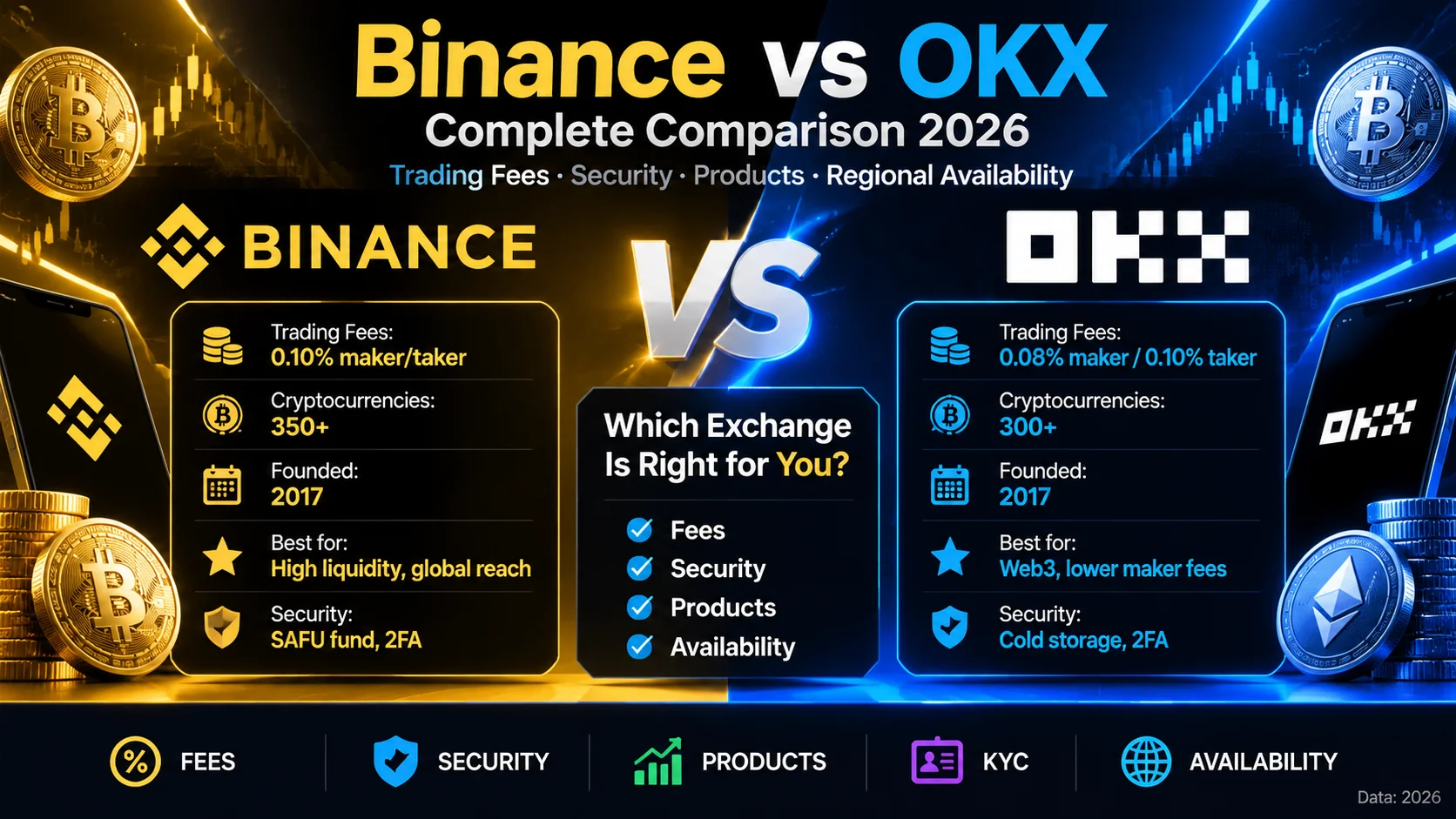
Binance vs OKX: Which Is Right for You?
An honest side-by-side of Binance and OKX — trading fees, availability by region, KYC, security, and products — with a clear rule for choosing.
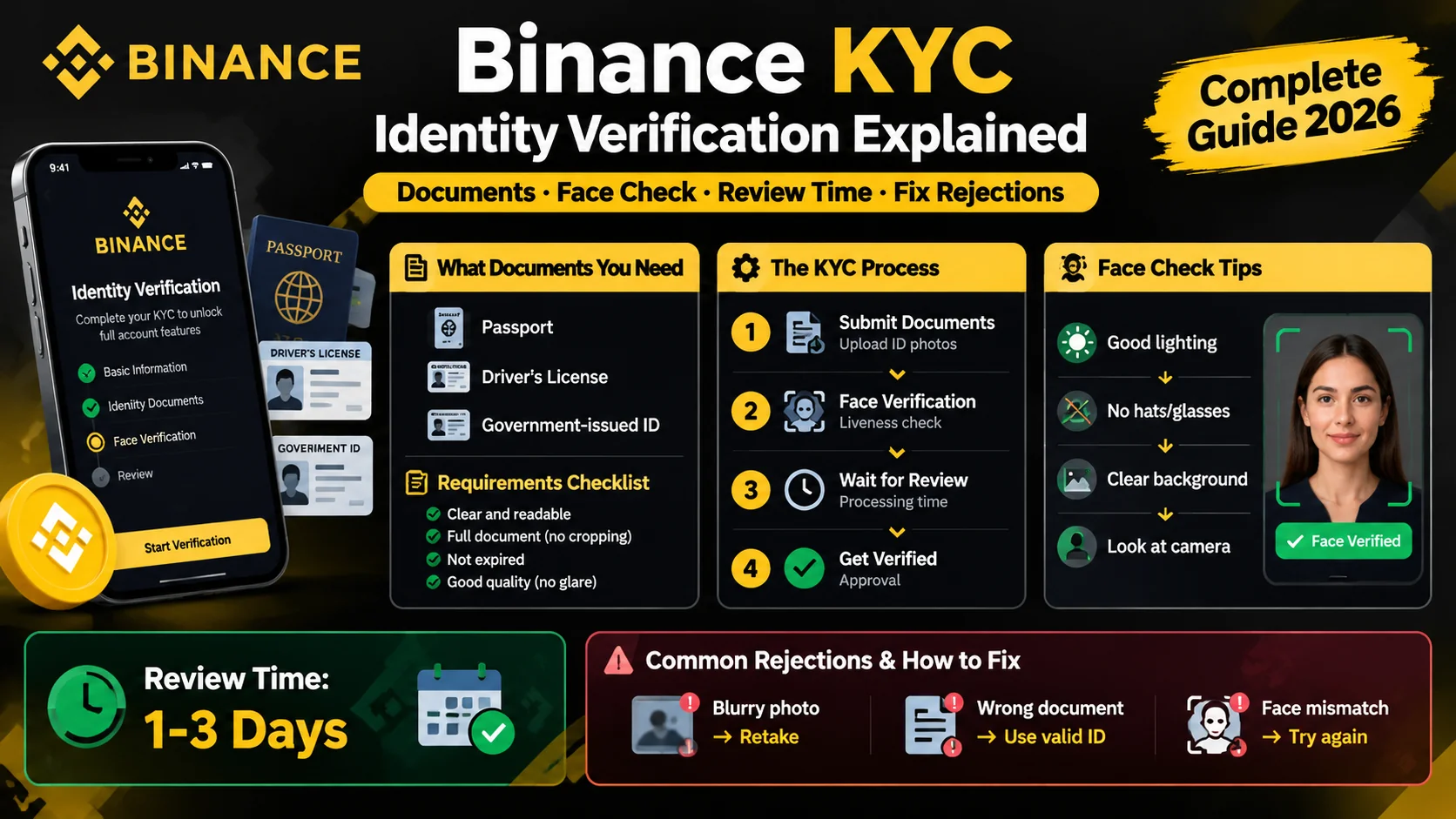
Binance KYC: How Identity Verification Works
Binance requires KYC before you trade. Learn the documents you need, how the face check works, how long review takes, and how to fix rejections.